

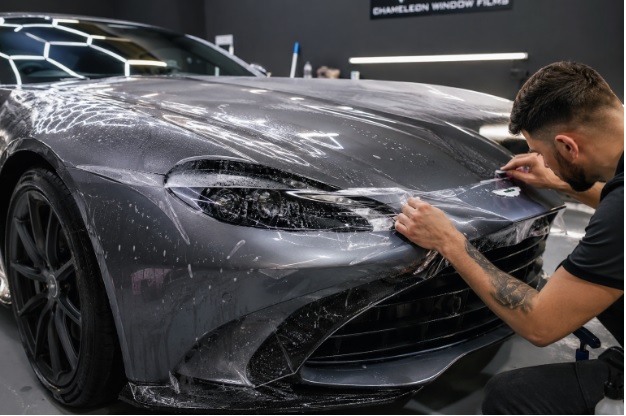
Protecting a car’s paint used to be fairly straightforward. A good wash, occasional polish and a layer of wax were usually considered enough. Today, however, owners have far more choices. PPF film and advanced surface coatings such as borophene coating are increasingly discussed by people who want to keep their vehicles looking newer for longer.
At first glance, both seem to offer the same thing: better paint protection. In reality, they work quite differently. One creates a physical barrier over the paint, while the other is a surface treatment designed to change how the paint behaves.
So, which one should a car owner choose?
What PPF Film Actually Does
PPF stands for Paint Protection Film. It is a transparent, flexible film installed directly over painted panels.
Its biggest strength is physical protection. When small stones, road debris or minor abrasions come into contact with the vehicle, the film takes the initial impact instead of leaving the factory paint completely exposed.
That is why PPF is commonly installed on the front bumper, bonnet, front fenders, ORVMs and door edges. These areas tend to collect more chips and scratches during everyday driving.
Modern films can also include self-healing top coats. Depending on the product, light surface marks may become less visible when exposed to suitable heat.
It is important to keep expectations realistic, though. PPF is not a force field. A severe impact can still damage the film and potentially the panel underneath.
Understanding Borophene Coating
Borophene coating belongs to a newer generation of automotive surface-protection products. Borophene itself is a two-dimensional material that has attracted significant interest in materials science because of its unusual structural and physical properties.
In automotive applications, borophene-based formulations are promoted primarily for their surface characteristics. Depending on the formulation, they may provide improved slickness, water repellency and resistance to everyday contaminants.
The key difference is that a coating is not intended to act like a thick impact-absorbing film.
That distinction is easy to overlook when comparing premium detailing packages. A coating can make the paint feel smoother and easier to maintain, but it cannot offer the same physical barrier as PPF.
PPF vs Borophene: The Main Difference
The easiest way to understand the difference is to consider what happens when a stone hits the bonnet.
With PPF film, there is a physical layer between the stone and the paint. The film is specifically engineered to absorb and distribute some of that impact.
With a coating, there is still only a very thin protective layer over the paint. The coating may improve resistance to environmental contamination and minor surface marking, but it is not designed to stop stone chips.
For impact protection, PPF therefore has the clear advantage.
For surface maintenance and water behaviour, a high-quality coating can be extremely useful.
Which One Is Better for Daily Driving?
Your driving habits should influence the decision.
A car that spends hours on highways every week is exposed to considerably more road debris than one used for short city commutes. In that situation, protecting the front end with PPF can be a sensible investment.
Someone who mainly wants a glossy finish, easier washing and resistance to environmental contaminants may be perfectly happy with a coating.
Parking conditions matter too. Cars frequently parked outdoors face greater exposure to sunlight, rain, dust and bird droppings. A suitable coating can make dealing with these contaminants easier.
Which Protection Offers Better Value?
There isn’t one answer for every vehicle.
PPF generally makes more sense when preventing stone chips and physical damage is the priority. It can be particularly valuable on a new car whose owner wants to preserve the original factory paint.
A borophene-based coating may be more appealing when appearance, slickness and easier maintenance are the main concerns.
For owners who want both benefits, using PPF on vulnerable sections and a compatible coating elsewhere can provide a more complete protection strategy.
Conclusion
The comparison between PPF film and borophene coating isn’t really about declaring one technology the winner. They are designed to address different forms of wear.
PPF provides a physical shield against impacts and abrasions. Borophene coating focuses more on the surface itself, helping with properties such as water repellency, slickness and resistance to environmental contamination.
For serious impact protection, PPF is the stronger choice. For easier maintenance and enhanced surface behaviour, a quality coating has its place.
Ultimately, the best solution depends on how the car is driven, where it is parked and how much importance the owner places on preserving the original finish. Understanding those differences makes it much easier to spend money on protection that actually suits the vehicle.